Tuesday, December 30, 2008

281206 English class #2 - part 1

Earlier in the day, Mr OD had caught hold of the cat as it returned to the guesthouse from Talat Phousi. He'd majored in English at the National University of Laos (NUOL) in Vientiane, & taught English at a private college in the evenings after finishing his day job at Vanvisa & Villa Lane Xang. Would the cat come to his class tonight?

The cat had never heard of that college before & had no idea where it was. Its Lao teachers didn't think it a good idea for the cat to go off on some strange guy's motorbike at night to what-might-turn-out-to-be-destination-unknown. Lao girls don't do that. Neither should Lao-looking non-Lao girls, in their opinion. Discussion ensued, during which the cat realised that they were rather clueless at reading maps & figuring out directions despite having covered 4-5 years worth of secondary & high school Geography classes. Things straightened out after the cat scratched out a rough map with a stick on a blank canvas of sandy ground. At the end of it they stuck fast to their pre-discussion decision that stocky novice & Monk Tata Young-fan would walk the cat to the college that evening. Forget Mr OD's motorbike.

All photos without humans taken during 2008 visit.

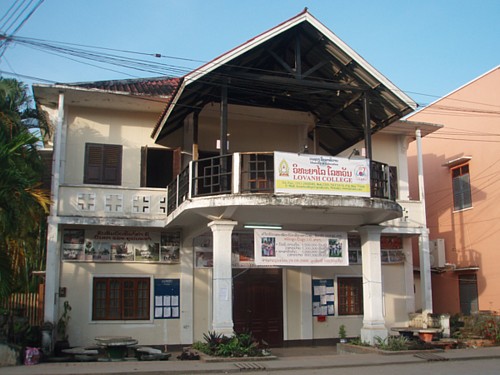
Lovanh College turned out to be a double-storeyed bungalow less than 3 blocks away in Ban Viengkeo:
PA150007

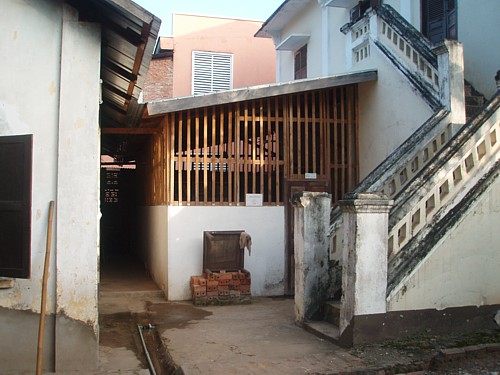
The college used to be located further away, but moved here when previous lease expired. Current location is a little too small, hence the additional classroom built at the back in the space that would usually serve as the outdoor kitchen area in Southeast Asian homes:
PA150005

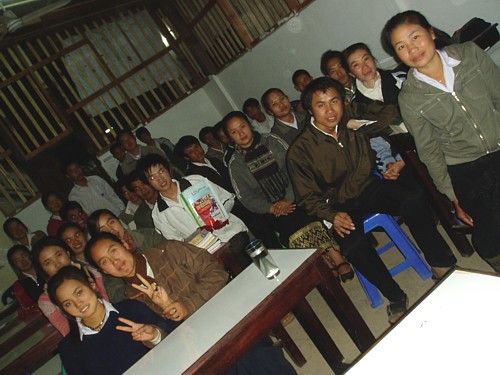
Which was the very classroom Mr OD's class was held in. This being an evening class, there were a few working adults in addition to the requisite novice monk (every college class in Luang Prabang seems to come equipped with at least one representative of the local sangha). As happens everywhere in schools that have a 'free seating policy', the front half of the class was occupied by the keener students...if the cat had its way, it'd start off such lessons by asking the front & back halves of the class to swop seats ;)

Souphanouvong University students appeared to make up the bulk of the class, many of whom were from other northern provinces & admitted under the quota system, whereby a certain percentage of university places are reserved for top-scoring high school graduates of every province. It comes with full tuition & board covered by the Lao government, & is aimed at levelling the playing field for students from more remote & less developed areas. The remainder of the university places are for competitive admission under the 'special system' for self-funding students, with separate entrance exams for every faculty. Sounds straightforward, but things are always way more complicated than meets the eye. Even in the supposedly meritocratic system that the cat is all too familiar with, there will always be the better-deserving who end up making way for the better-connected & better-off.

Among the Souphanouvong students were a few Business majors, a Maths major, & surprise surprise, English majors - what on earth were English majors from the local university doing in this class? Puzzled cat didn't probe further, but two years later it was to learn about some episode where the English majors were left with no lecturer for almost an entire semester after a Lao staff was dismissed by the South Koreans(*) for corruption...when a replacement was found, the students were made to cram an entire semester's worth of curriculum into the remaining one month of term...

Lao people are very shy...or so the cat has heard many more times than it can count on all four paws plus all whiskers. This went straight out of the window, or rather the gaps between the wooden slats (see above photo). The floor was thrown open & time flew by once Novice Phongsaly #2 got the ball rolling...& rolling & rolling - he spoke pretty well but had no pause/stop button! The difficulty was more of ensuring that everyone had a chance to speak & that the cheekier guys didn't reveal anything too scandalous (by Lao standards) about their female classmates under the pretext of practising their spoken English :P

All students were given the option of writing down anything they wanted to say & double-checking with Mr OD for any glaring bloopers - this way the usual excuses of keeping quiet for fear of blanking out mid-sentence or saying the wrong thing were naught. Those who resorted to this usually mustered enough confidence to speak/question off-the-cuff after one or two written sentences/questions.

Another strategy was to get them to speak on topics most familiar to them (family, village, aspects of everyday Lao life, etc), where it is difficult to come up with a 'wrong answer'. Those from Western(ised) societies are so accustomed to MAKING THEMSELVES HEARD without fear of reprisal, VOICING THEIR OPINIONS is second nature...whereas in Asian societies the further one sits down the hierarchy the more one should be seen but not heard & the more suicidal it can be to say the wrong thing *cue dead silence followed by nervous laughter*...perhaps this is one reason why the 'model answer' country where the cat comes from is sorely lacking in the truly articulate who can distill insightful thought into succint word?

Hard to get everyone in even with the photographer's back against the wall:
PC280163

Glass of water in foreground was served to the cat. But they made the cat laugh so much it couldn't drink.

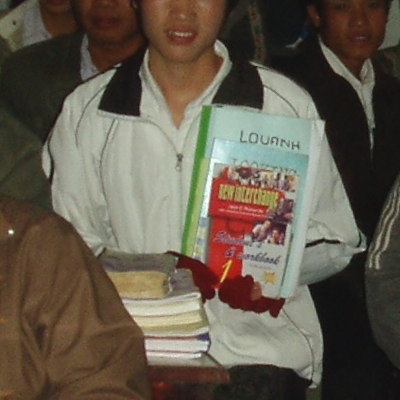
Most enthusiastic were the 'quota students' from Houa Phanh & Phongsaly, who also had the dustiest feet - after class they walked back in near darkness to their university dorms. Mr Excuse Me doing the usual textbook advert pose with his holey red gloves:
PC280163a

Once upon a time, this 'quota student' was given the impression that the polite way to begin any sentence in English was with the words 'Excuse me (please)'. The largest book (with green spine) held by him is a typical Lao college textbook - 100% photocopied on A4 paper & stapled together or soft-bound. One of the cat's Lao consultants uses a stack of such 10,000kip texts for Law school at NUOL. Earlier this morning, the cat had seen the red New Interchange textbook for sale at Talat Phousi.

to be continued...

* The construction of the new Souphanouvong campus was funded by South Korea; Lao academics were also brought over to Korean universities for training & Korean staff sent over to Luang Prabang to get things up & running.

Saturday, December 27, 2008

281206 brown = sii sooker

On the cat's last two afternoons in Luang Prabang, it attended Lao classes taught by many more teachers than it expected. Even in the Oxford tutorial system or Cambridge supervision system, one would never get to enjoy a 10-odd:1 teacher to student ratio, what more with zero tuition fees. The curriculum took a comparative approach (similarities/differences between Lao & Thai equivalents) & was custom-built upon the cat's rudimentary Thai vocabulary. Some of it was rather straightforward:

day before yesterday = meu korn [LA] vs. (meua) waan seun (nii) [TH]
yesterday = meu(a) waan nii [LA] vs. meua waan (nii)/wan waan [TH]
today = meu nii [LA] vs. wan nii [TH]
tomorrow = meu eun [LA] vs. phrung nii [TH]
day after tomorrow = meu heu [LA] vs. mareun(nii) [TH]

Sometimes a little linguistic gymnastics was required:

red = sii daeng [LA, TH]
orange = sii som [LA, TH]
yellow = sii leuang [LA, TH]
green = sii khiao [LA, TH]
blue = sii faa [LA] vs. sii naam ngoen [TH]
purple = sii muang [LA, TH]
white = sii khaao [LA, TH]
pink = sii somphuu [LA] vs. sii chomphuu [TH] (lit. colour of jambu air)
grey = sii thao [LA, TH]
brown = ...

Sii sooker says Monk Tata Young-fan.
Cat writes down 'sii sooker'.
Whole bunch of teachers peer at cat's writing.
No, no, sii sooker.
Erm that's exactly what the cat wrote?
NO, sooooo-khaaaa.
*scratch head*
meuan kan kap phaasaa thai (it's the same as Thai)!! sookha SOOKHA!
Isn't 'sukhaa' (สุขา) a polite term for toilet in Thai?!
You don't know how to write in English? EHS-YOU-JII-
OH SUGAR!!!!

(brown = sii naam dtaan aka. 'colour of sugar' in Lao & Thai)

Come think of it, brown is indeed a colour associated with (filthy) toilets. When we were all able to breathe again after recovering from the mass laughing fit, the cat taught its teachers how to pronounce SHOO-GER. Interestingly, most of the Lao the cat has met have no trouble pronouncing 'sh', unlike most Thais who tend to morph it into 'ch' instead, & love to spend their free time 'chopping' for 'choo' (perhaps they buy only Jimmy Choos) & watching 'cho' at movie theatres. The 'shr' phonetic is way beyond some - can be a little freakish when a Thai tells you that tom yam kung contains 'chimps'.

On the other hand, the removal of the 'ch' consonant from the Lao alphabet means that many younger generation Lao have trouble pronouncing it, morphing 'ch' in any other language into 'sh'. Hence 'do you want share?' when offering you a chair, 'the price is sheep' when the currency is kip, & the rather alarming 'I shat on MSN & Yahoo messenger' & 'he shit in exam for high school'. This also makes it harder for Lao to figure out the difference between 'ch' & 'q' when learning Chinese. The absence of the 'r' consonant in the Lao alphabet gives rise to the tendency to replace 'r' with 'l' or simply ignore it, resulting in car clashes involving bad divers, painting walls with blush, clothes dying in the sun, & monks who play Buddha every morning & evening (Laoglish grammar tends to omit prepositions like 'to').

The French influence on Laos shows up in English too - whatever's spelt with 'ou' in English & Chinese ends up being pronounced as 'oo' instead, & Big Brother Mouse sprouts antlers to become Big Brother Moose...books for Canadian kids? Most of the Lao whom the cat has met (all from upper north except for one) can distiguish between 'v' & 'w' (listening only), & even pronounce the difference between 'x' & 's', despite the fact that the cat's Lao-English dictionary does not list 'x' or 'v' as consonants (the 'x' for elephant is transliterated as 's'). Much easier to teach Lao how to pronounce 'thank you' in Chinese than to teach Americans & Europeans (who tend to morph the 'x' into 'z').

Despite this afternoon's Lao lesson, the cat was still ill-prepared for the next test of Lao language it faced upon returning to Vanvisa Guess-how (final consonant 's' & consonant cluster 'st' do not exist in Lao)...

Younger female staff converge on cat.
Animated discussion in Lao.
Ask it, ask it, it understands some Thai.
Madame Vandara (English-speaking owner) bor yuu (not in)?
Mr OD (sole English-speaking employee) not in either...
Staff grabs cat's paw & leads it upstairs.
English-speaking falang lady emerges from room next to the cat's.
Missing what?
Cat has no idea what bras are called in Lao. Not exactly the kinda vocabulary monks like Tata Young-fan would ever think of teaching it.
Oh good the Lao ladies understand 'seua chan nai' (Thai term for undergarment).
Erm sii muang is purple but no idea what lavender or lilac is called in Lao or Thai.
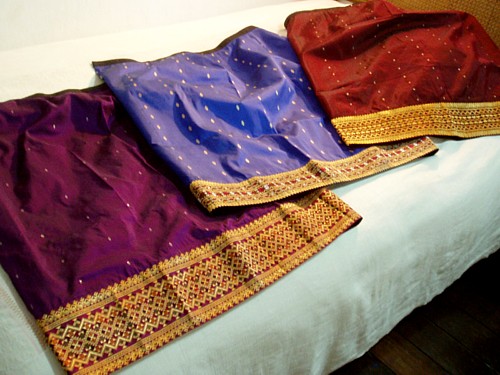
Madame Vandara's textile collection downstairs!
Point out exact shade from pile of folded silk scarves.
Ohhh...
Staff hunt for falang's lavender seua chan nai in guest laundry :)

For the record, lavender = sii muang orn...the same 'orn' (in 'orn bpanyaa' lit. weak wisdom/intellect) used to scold people 'dumb' or 'stupid' :P

Thursday, December 25, 2008

281206 the quiet in the land

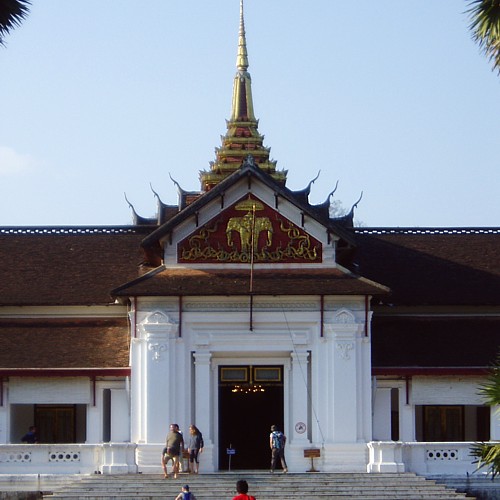
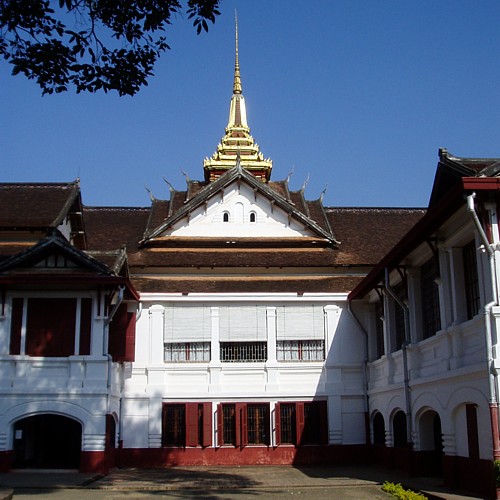
The former Royal Palace, now used as the National Museum:

PC270180

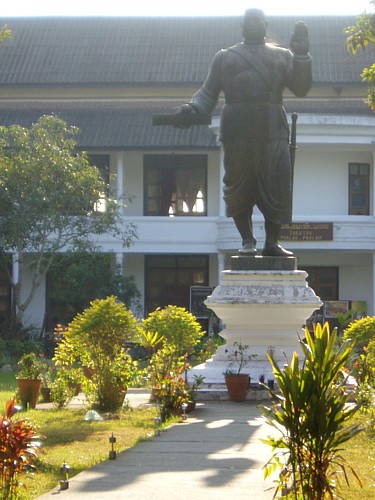
Elsewhere on the grounds directly across from Hor Prabang, a huge statue of the last king ever crowned, King Sisangvangvong:

PC270183

Behind him is the former Winter Palace that now houses the Royal Ballet Theatre.

ຊ້າງສາມຫົວ xang saam hua (lit. elephant three head) under a parasol,
the symbol of the former kingdom of Lane Xang Hom Khao (lit. million elephants umbrella white)...

PC270166

...with each head of Erawan representing the former kingdoms of Luang Prabang, Vientiane & Champasak...

PC270182

...now eclipsed by the national flag of the Lao People's Democratic Republic:

PC280159

This was the closest the cat ever made it into the museum. Instead, while hunting for the loo, it stumbled upon this...

PC290294
PC290294a

...& ended up entering the former palace from the back...

PC280160

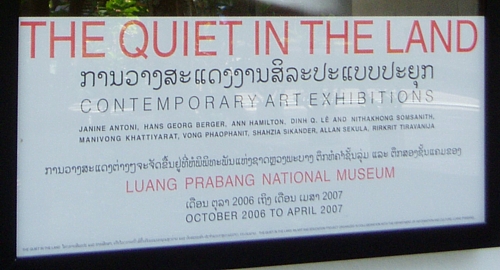
...& spent hours viewing these works on display for the exhibition entitled The Quiet in the Land. In an adjacent building, there was more...

PC290293

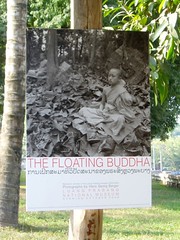
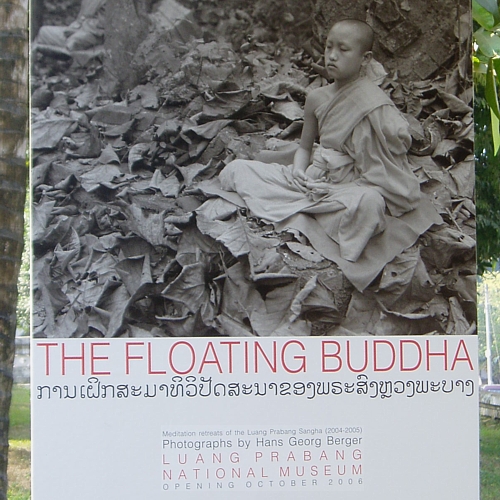
...a series of photos documenting the first two years (2004 & 2005) when vipassana medition training was reintroduced for the Luang Prabang sangha & held at Wat Pa Phon Pao, with support from the lay people of Ban Phanom:

PC290293a

It has since become an annual 10-day retreat for final year (Matthayom 6) monk & novice students of the Buddhist high school in Luang Prabang. The cat didn't manage to finish browsing through all the exhibits before the 4PM closing time, & would return the next day - this was one of the highlights of the cat's visit to Luang Prabang.
The exhibition also featured two documentary films. All That's Solid Melts into Air (Karl Marx) by Vong Phaophanit & Claire Oboussier was a collection of all sorts of little details of the sights & sounds of Luang Prabang town - interesting enough for the cat to watch twice. On the other hand, A Short Film for Laos by Allan Sekula started off cryptically with some cowboy western scene (?! *scratch head*), followed by the removal of a drainage tube from someone's (Sekula's?) leg post-surgery (??!!), before abruptly switching to a Lao man in Tham Piew describing (scroll to 1:38 in this video) how on 24th November 1968, almost 400 Lao civilians sheltering from American bombing raids on civilian targets during the second Indochina war (aka. Vietnam war) were obliterated when two of the four missiles launched at the cave found their target (according to the official Lao version of history). The film then moved on to cover the Plain of Jars (also in Xieng Khouang province like Tham Piew) & the blacksmiths of Ban Had Hian, a village near Luang Prabang airport. Most of the few visitors who'd stumbled upon this exhibition walked out of the tiny screening room moments after entering, & the museum staff keeping watch in a corner did his job in his dreams :P
Museum cat happily dozing in the quiet of the land that is Laos - also a member of the museum staff?

PC280162

281206 cutting skirts

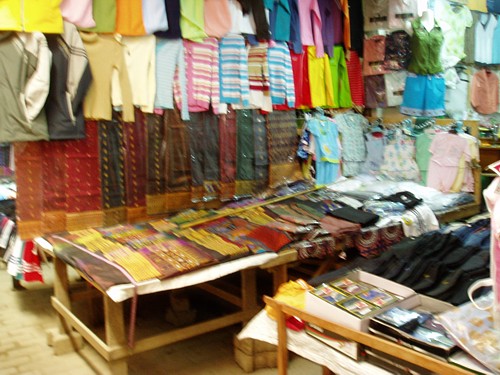
After wandering around the previous day, the cat was a lot more familiar with the layout of the big fat Talat Phousi. The part that appears in this photo shelters mostly clothing stalls, & the middle section with the lower roof has the higher end stalls nearer to the entrance that sell the fanciest Lao outfits made from better quality silk that locals splurge on for weddings. More pocket-friendly Lao sinh (skirts) are found in the left section, which was where the cat was headed:

PC280149

Stalls selling school uniforms, watches, electronics, textbooks, dictionaries & other books are also found in this front section. The right-most part of this front section has a stall or two dealing in ready-made Hmong traditional outfits including various sizes of headgear & materials for DIY embellishment, & somewhere to the left (& outside) of that photo is a row of shops dealing in big fat items like satellite dishes. Interesting how satellite dishes are sold so freely & found sprouting from the humblest of bamboo-&-wood huts in rural villages in a communist country...when in Singapore ordinary citizens are not permitted to own any, & foreign embassies, etc have to fork out the equivalent of 6.5 million kip per year for a permit, per dish.

Behind this front section are the stalls selling dry goods such as toiletries, & behind them are more stalls selling edible dry goods such as packaged food (instant noodles, biscuits & the like), dried fish, spices, kheua/mai sa khan (spicy wood of Piper ribesioides), khai phaen & uncooked rice. Right at the back, both sheltered & in the open, is the 'wet market' section with stuff like vegetables, banana flowers, fish barely swimming in tubs of water & freshly butchered meat.

The cat's loot - lightweight, practical souvenirs that can be folded & flat-packed like IKEA goods:

PC280150

Lao sinh are usually sold with a matching hem piece (ຕີນ dtiin, lit. foot) tacked on for display:

PC280157

Stalls usually have plenty of loose hem pieces (bottom left of first photo in this post) for customers who want to mix & match their own choice of cloth & hem pieces. The formal/wedding sinh that come as a whole outfit are trickier, since the accompanying scarf can be of a pattern identical/similar to that of the hem piece. There are also types of sinh material that do not come with separate hempiece, like this, this & this. There will usually be a sewing machine within the stall for on-the-spot tailoring (ຕັດສິ້ນ dtat sin lit. cut skirt), failing which the stall owner will direct customers to a nearby seamstress; both ways, tailoring can be done as quickly as within an afternoon.

This was the cat's first time ever getting clothes tailored. It walked away with three lessons learnt...(1) moneybelts stuffed with baht & kip skew measurements - dumb cat forgot all about its moneybelt & ended up with three sinh that were too loose! (2) specify whether you want the fold in the sinh to be right-over-left or left-over-right - clueless cat ended up with two sinh of the former & one sinh (tailored at a different stall) of the latter (3) specify whether you want a lining, usually made using thin black cloth, to prevent supplementary weft threads on the inside of the sinh from running & becoming worn by friction - ignorant cat ended up with one sinh with lining & two without.

The fold in the sinh means that if the cloth is not long enough for larger girths, it can be extended by sewing on a narrow panel of cloth (usually cheap black material) such that it will be hidden within the fold when the sinh is worn...something noticed while looking at the falang-sized sinh sold in the Luang Prabang night market. For the record, the cheapest sinh (25-28,000kip) are black or blue cotton with white hem pieces aka. the school uniform for Lao girls, but one has to be cat size or smaller to fit into them :P

Most Lao women appear to opt for darker shades for everyday wear (more practical since dirt doesn't show up that easily), & the prettier jewel colours for special occasions. Guess that might explain why the bright colours tend to be of higher quality & more expensive material? The cat hunted high & low for a nice shade of green but all it could find were dull muted dark greens or light olive shades that look too much like the uniforms of Lao women soldiers & policewomen respectively...it would eventually hit paydirt in Huayxai market just before leaving Laos.

Receipts given to the cat were handwritten on small slips of paper torn from old desk diaries or sheets of A4 paper that had already been used on one side. Nice to see recycling in practice but not so nice to realise how those big fat rolls of paper inserted into cash registers, electronic payment terminals & ATMs to churn out mountains of receipts & transaction records - both merchant & customer copies - in more developed countries are so taken for granted. Looking at the squiggles on the receipts, the cat wondered how long it takes one to learn how to distiguish neat & beautiful from messy & illegible handwriting in a totally foreign language...

281206 flying catfood & rice-eating vehicles

On its way down Phou Si, the cat met locals trying to sell it still fresh & tweeting pre-packaged convenience catfood for lunch...

Many Buddhists believe that one can gain merit through the supposedly compassionate act of releasing flying catfood from cages to the skies & swimming catfood from plastic bags into ponds & rivers. However, merit through 放生 (fang4 sheng4) is supposed to be derived from saving the lives of animals that are facing imminent death (e.g. fish trapped in a pond that is drying up & birds snared for slaughter - see this story - & livestock bound for the abattoir)...rather than animals that have been captured specifically for the purpose of sale & release, leading to the perpetuation of a prolonged cycle of capture-release-capture-release-capture punctuated by spells of imprisonment. See here for a whole debate on the Phou Si catfood sellers.

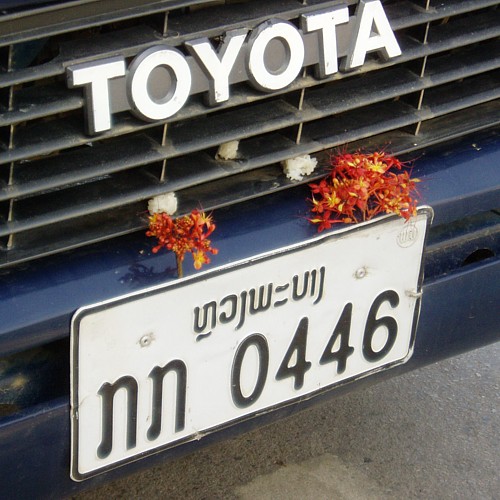
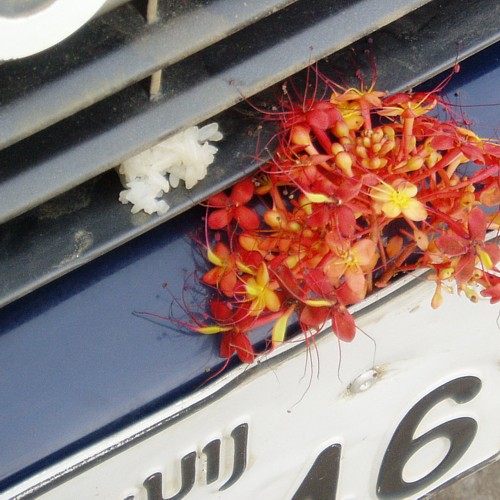
Vehicles do have sticky rice-chomping ຂວັນ khouan (souls/spirits):

PC280142
PC280143

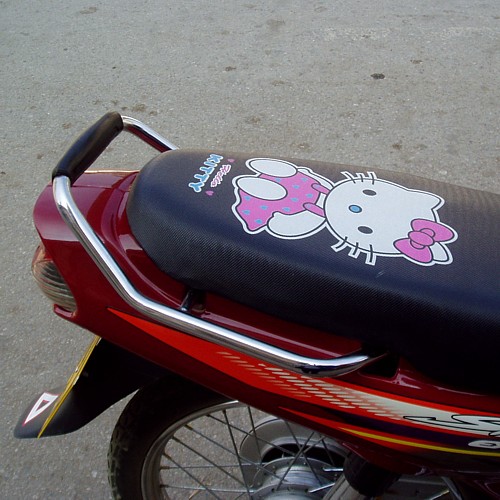
For man-maid:

PC280148

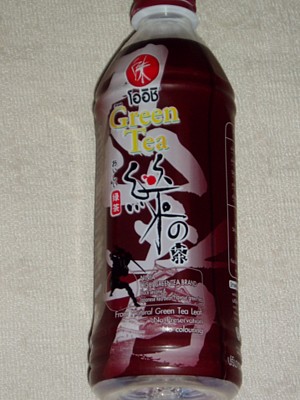
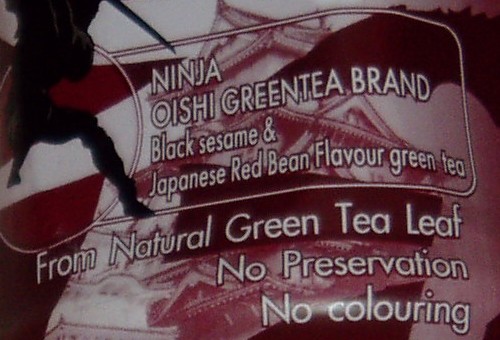
Because the cat has to try every strange flavour of green tea:

PC280146
PC280147

Wednesday, December 24, 2008

281206 Phou Si redux

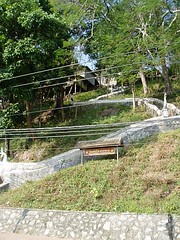
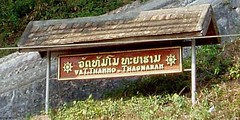
Up to the top of Phou Si again, since Mr Ticket Seller had stamped yesterday's admission ticket with today's date. The cat decided to skip this route that goes via Wat Thammo Thayaram...

PC280121 PC280121a

...& ascend by a path between some wooden houses further southwest. Two years later the cat would discover that its chosen path lies somewhere near the site of Wat Pa Meo (lit. temple forest cats), one of the 12(*) temples on the slopes of Phou Si, of which only five are still extant. Wat Pa Meo supposedly got its name because 'villagers use to leave their cats over there'...

Paintings drying on shrubs outside someone's kuti:

PC280122
PC280122a

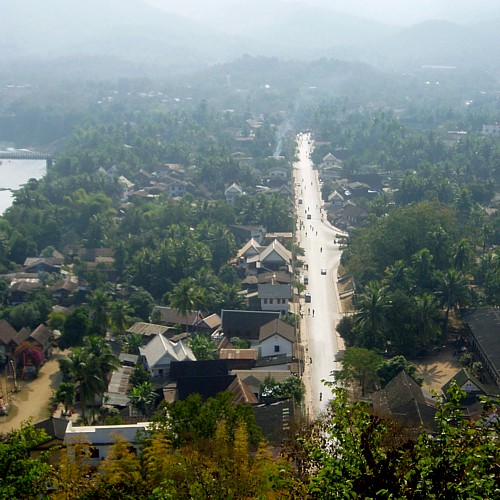
Phommathat Rd - still hazy, but clearer views than the previous evening:

PC280134
PC280133

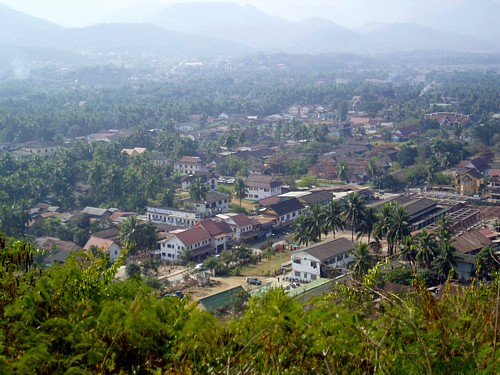
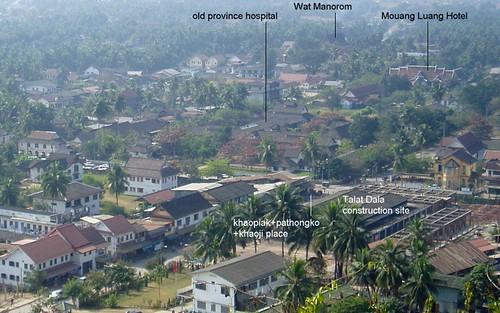
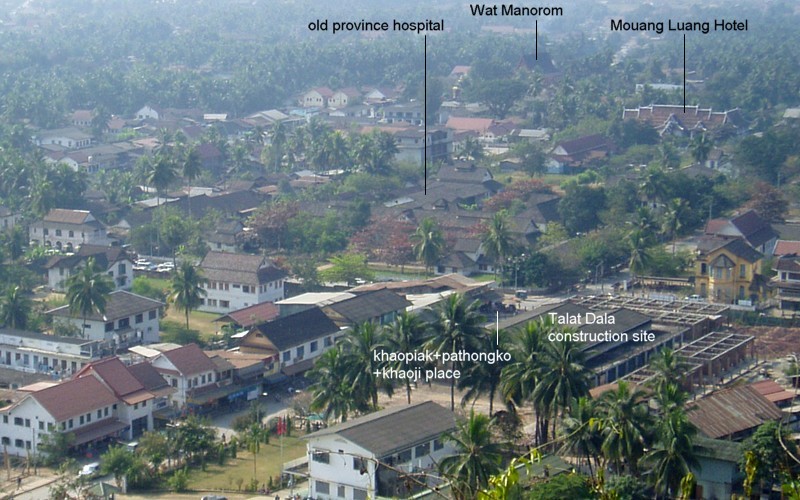
During this 2006 visit, Talat Dala was being rebuilt, & the province hospital had already been shifted out of the old site diagonally across from Talat Dala to Chinese-built premises south of town:

PC280133a
Click here to see full size image

During the 2008 visit, Talat Dala had been completed & reopened, & the old province hospital was being converted by Aman Resorts into yet another luxury hotel. The latter development was mentioned in a not exactly favourable manner in the 2007 report of the UNESCO WHC-ICOMOS reactive monitoring mission to the Luang Prabang World Heritage Site, which has this to say about the ongoing Disneyfication & gentrification:

At present, however, unprecedented pressure from development is posing new strains on the site which the existing conservation system appears unable to counter effectively. If the Lao traditional heritage, in particular, continues its steady decline, the Town of Luang Prabang is heading towards a situation that would justify World Heritage in Danger listing...

Illegal constructions and rapid land use conversion represent a growing threat to Luang Prabang’s significant intangible cultural heritage and to the spirit of the place (genius loci)...With the movement of local residents out into more peripheral areas and their replacement by tourists and commercial entrepreneurs, the continuity of attachment to place will be lost...

Gentrification by expatriate Europeans or by the Lao themselves may save the physical fabric, but it tends to work against maintenance of the intangible heritage, except in highly commercialised forms such as fine arts, exotic crafts and tourism performances.


(How the cat wishes there was some big-fat-clout organisation to knock this into the Singapore government for what they have done to sterilise + ruin places like Chinatown in the name of tourism.)

During its 2008 visit, the cat also discovered that its favourite roadside khao piak khao (porridge) + pathongko (fried dough fritters) breakfast place had disappeared - the house in front of which it sprouted up every morning had been torn down & was being rebuilt. Too tired to hunt it down, it turned to the busy place opposite Talat Dala that does the same thing (for double the price).

PC280130

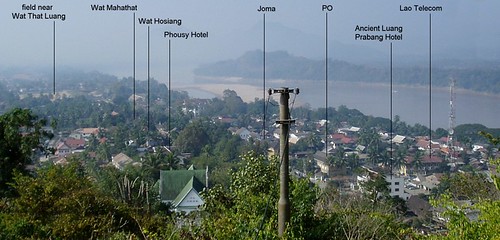
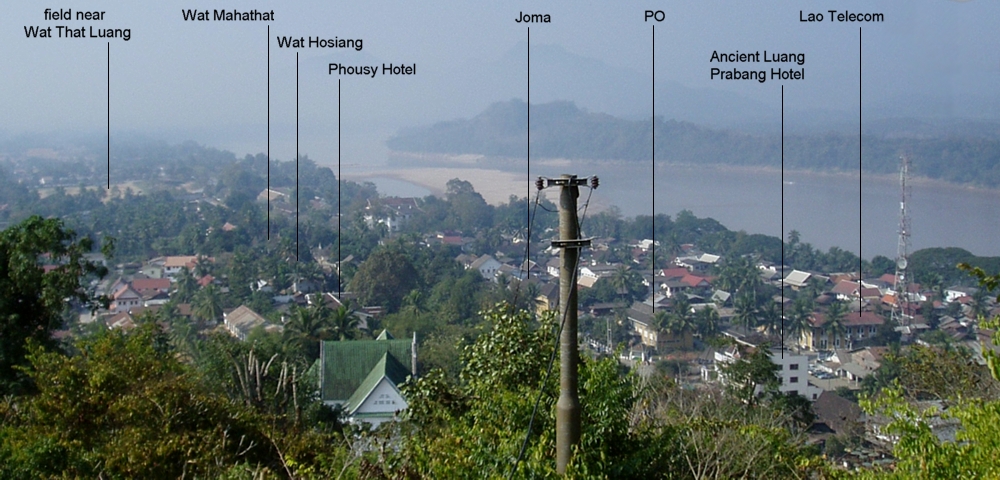
The multi-storey Ancient Luang Prabang Hotel sticks heads & shoulders above the surrounding buildings & trees in the World Heritage conservation zone:

PC280130a
Click here to see full size image

Chomphet district on the opposite bank of the Nam Khong:

PC280126-7
Click here to see full size image

In 2008 the governor of Luang Prabang would sign an MOU for a USD2 billion project (article source: Vientiane Times 231008) by Korean & Lao investors to transform Chomphet district into Diamond City, a new town with shopping malls, resorts, business service centres, a 36 hole golf course & a stock exchange on 3000ha of land to be leased for 50 years (extendable for an additional 20 years), & also a bridge across the Nam Khong to link up with Luang Prabang town. Prior to this, there were also plans to build such a bridge to connect the town to a proposed new airport in Chomphet district to be built by Chinese investors. So much for the 2007 UNESCO WHC-ICOMOS reactive monitoring mission report, which states that:

It is now urgent to revise the town’s urban plan and, as part of that, to identify a buffer zone to prevent inappropriate development that would negatively impinge upon the characteristics of the historic urban landscape. In the meantime, a stop should be put to...the development of a new town on the right bank of the Mekong...

A moratorium should be imposed immediately on major projects impacting on the OUV (Outstanding Universal Value) as outlined particularly in Section 4 above, and will extend until completion of the revised Urban Plan. This will include the new town in the Chompeth valley on the Mekong right bank...

Timeline: Immediate imposition of moratorium and notification of such to the World Heritage Committee by 1 March 2009.


Wat Mai:

PC280125a

Royal Palace museum:

PC280127a

Whether khon Lao & falang alike will continue to enjoy these views from Phou Si depends on whether these protective measures put forth in the report will ever materialise, & be effectively enforced:

(a) Chompeth valley – protection of agricultural activities; maintenance of
drainage systems; density and height control restrictions on any new buildings;
(b) Mekong downstream – protection of vista along river banks and up to crest of visible mountains;
(c) Wetlands – protection of agricultural activities and vegetation; any further residential development to be low density and low rise;
(d) Nam Khan valley and mountains – protection of sweeping vista from Phousi along the Nam Khan to the crest of mountains; restrictions might be limited to height control and preservation of vegetation cover.


Notes:

(*) Twelve temples on the slopes of Phou Si:
  1. ວັດຊຽງງາມ Wat Xieng Ngam aka. ວັດປ່າຝາງ Wat Pa Fang
  2. ວັດປ່າແຄ Wat Pa Khae aka. ວັດສີພູດທະບາດເຫນືອ Wat Siphoutthabat Neua
  3. ວັດປ່າຣວກ Wat Pa Houak
  4. ວັດທັມໂມ Wat Thammo
  5. ວັດຈອມສີ Wat Chom Si
  6. ວັດສາວຫລຽວ Wat Sao Liao (gone)
  7. ວັດປ່າທຽບ Wat Pa Thiap (gone)
  8. ວັດທ້າຍພູ Wat Thay Phou (gone)
  9. ວັດຫໍຄ່ວງ Wat Ho Khouang (gone)
  10. ວັດທາດເນີ້ງ Wat That Noeng (gone)
  11. ວັດຂາມລ່ຽມ Wat Kham Liam (gone)
  12. ວັດປ່າແມວ Wat Pa Meo (gone)
The viharn of #1 was used as the library of the Buddhist high school in #2 & has since been converted into a classroom; #3 is directly opposite the Royal Palace museum entrance gates; site of #7 is now a huge Bodhi tree planted to commemorate the 2500th anniversary of Gautama Buddha, up the stairs from #3; the cat suspects that site of #8 is around the former residence of the French governor, & that of #10 is somewhere around the Children's Cultural Centre & National Library, opposite Phousy Hotel.

281206 Nam Khan

Looking across to the Ban Phanluang side of the Nam Khan:

PC280116

Kataw (sepak takraw) court marked out on the riverbank, with the typical Lao-style kataw court floodlight - a long fluorescent light tube or two mounted on a wooden post standing at the midpoint of the sidelines, with a piece of corrugated zinc sheeting to shelter the light tube from rain:

PC280116a

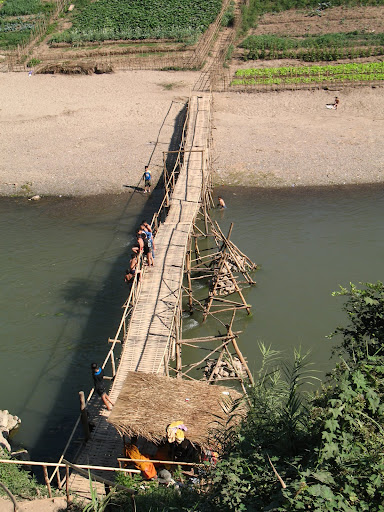
Guess it's for dry season use only, as the Nam Khan floods well above that level. Every dry season, a bamboo footbridge is built over the Nam Khan as a shortcut to town for residents living on the other bank, & is swept away when the rainy season arrives.

PC280112
PC280113

Prized fighting cockerels:

PC280115
PC280110
PC280117

An all-in-one larder + laundry tub + playground + bathroom + irrigation source + swimming pool:

PC280118-19-20

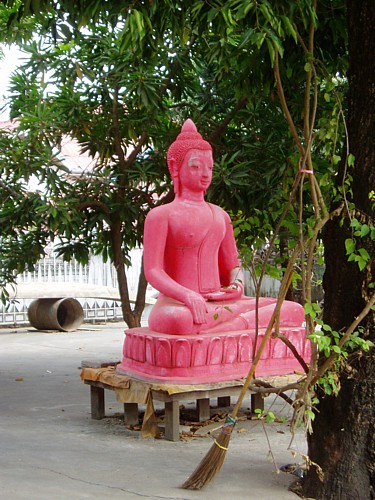
281206 Wat Saen - red Buddha & nescafe broom

Incomplete - the monk who was making it decided to return to lay life:

PC280085

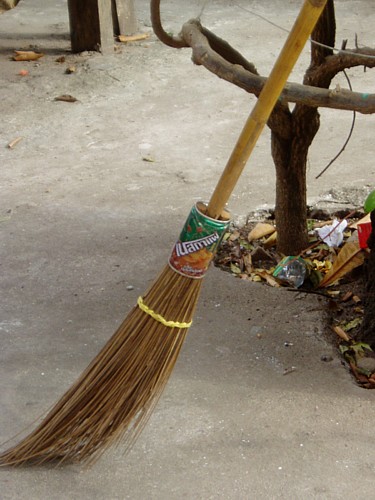
Nescafe broom:

PC280086

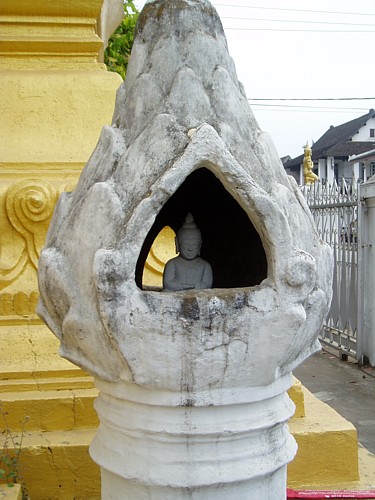
Lotus hideout:

PC280061
PC280060

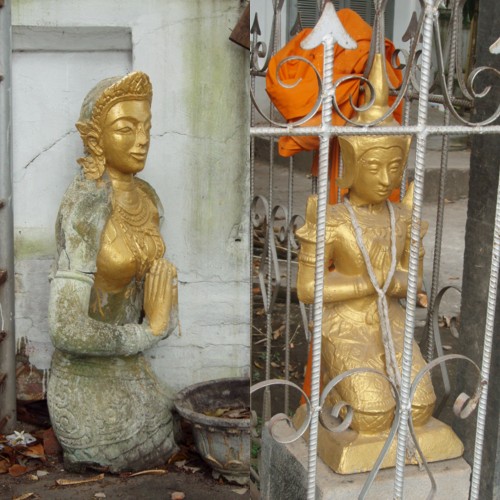
Anyone knows who the lady at below left is?

PA140415-7

Resembles the rice goddess แม่โพสพ Mae Phosop, but she isn't holding a sheaf of rice plants...& also looks like the Beckoning Lady นางกวัก Nang Kwak, but she doesn't have one hand raised in maneki-neko style to attract fortune...

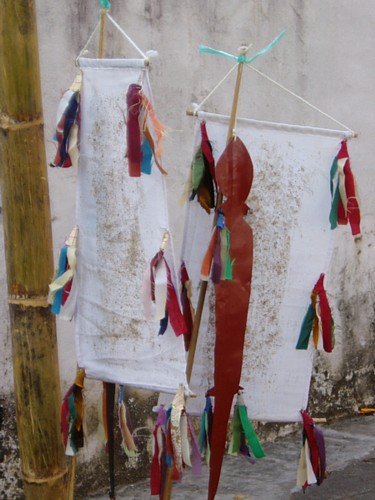
At the base of a bamboo pole holding up a long banner:

PC280109
PC280107
PA140443

281206 Wat Saen - Buddha footprint

Photos from October 2008 trip...

PA140420

The 'twin miracles' (ยมกปาฏิหาริย์ yamaka patihariya):

PA140421

On hearing that Buddha was to perform a miracle at a mango tree, disbelievers wanting to discredit him bought over all mango orchards & cut down every single tree. Buddha then ate a mango & had the king's gardener Ganda plant the seed. A fully grown tree sprouted instantly, at which Buddha created double apparitions of himself, depicted as one pair each of reclining & sitting Buddhas in the tree.

It is widely believed that Buddha forbade his followers from making any paintings or sculptures of him after his death, & this is the reason why early Buddhist art is aniconic, where Buddha was represented by symbols like an empty throne, a Bodhi tree, or his footprint instead. This is the reason why Buddha footprints, many of which can't possibly be actual footprints, are found in places where Buddhism is practised, including countries where there is no record of Gautama Buddha ever having travelled to. The whole idea of footprints as a representation of Buddha probably came from the practise of showing respect by prostrating oneself before the feet of deities & elders. The Buddha footprint (phouthabat) in Wat Saen:

PA140427
PA140429

All five toes of the same length, a Dharmacakra (wheel of Dhamma) in the middle of the sole, & 108 auspicious symbols...

PA140428

...although no matter how the cat tries to count, there seem to be 109...

Tuesday, December 23, 2008

281206 Wat Saen - boat & drum

Ban Wat Saen's longboats:

PA140418

During ບຸນຫໍ່ເຂົ້າປະດັບດິນ Boun Hor Khao Padap Din (lit. festival wrap rice decorate earth) on the new moon day around late August/early September, Luang Prabang's annual longboat races (ຊວງເຣືອຍາວ suang heua yao) are held on the Nam Khan. People leave offerings of hor khao (little packages of rice wrapped up & steamed in banana leaves) around their homes & temple grounds for the spirits of the deceased, & 'boats' made from banana tree stems (looks like triangular, leaf-less & flower-less krathong) are floated on the river or left on the banks at various sites along the Nam Khong & Nam Khan where nagas are believed to live.

PA140418a

Each boat is believed to have two female khouan (spirits) called Nang Heua (lit. Miss/Lady boat) in it, so offerings have to be made before the boats can be used:

PA140416

Interesting how the timing of this festival overlaps with 七月 (seventh month in the Chinese lunar calendar aka. 中元节 Hungry Ghosts festival), & shares the same elements of making food offerings to the spirits of deceased relatives...the Thai version described here shares even more similarities - the whole idea of the gates of hell being opened for the whole month for spirits of the dead to roam the mortal world & enjoy the food offerings & entertainment provided by the living to appease them. Not sure if it's only Luang Prabang town that holds boat races at this time of the year - Ban Xieng Ngeun further up the Nam Khan, Vientiane & elsewhere in northeast Thailand (e.g. Sakon Nakhon) have theirs in October during Boun Ok Phansa (end of Buddhist Lent/rains retreat) instead.

Wat Saen's alarm clock doubles up as a car shelter:

PA140431
PC280098

Sunday, December 21, 2008

281206 Wat Saen - big bird, eating house

The building (below, left) beside the viharn, which a cat's Lao consultant refers to as an 'eating house':

PC280078

According to him: it use for meeting and chanting, some time there's a special ceremony they will have a meal inside. It looks like small but its inside is quite large and it's easy to walk. this is because there has no too much statue inside.

Click here to watch someone's video of this building in use during the former abbot's wake. The roof is supported by eave brackets less elaborate in design than that of the vihaan...

PC280093

...& the stairs lack balustrades - no fish-wielding makara here:

PC280079

One of the two buildings directly behind the viharn:

PA140433

Not sure who exactly the four-faced Pha Phom (Brahma) & other deities are worshipping:

PA140434

The central figure is sitting upon a lotus flower & resting his foot on a smaller bloom, but is still wearing a crown & the clothing of a prince, & lacks a halo around his head...might he be Maitreya (aka. Ariya Mettayya), the future & fifth Buddha of the present universe?

The other building directly behind the viharn:

PA140437

Two white nagas twirling in a beautiful way:

PA140437a

Buddha stepping on a hermit:

PA140437b

In a previous life, the future Gautama Buddha was Sumedha, the only son of a rich couple in the city of Amaravati, who gave away all his inherited wealth & became a hermit in the forest. On hearing that the Dipankara Buddha (aka. พระทีปังกรพุทธเจ้า Thipangkon Buddha) was coming to Amaravati, Sumedha set about repairing the road in preparation for his arrival. However, he was unable to finish in time, & prostrated across the muddy incomplete section, offering his own body as a bridge (above left). Dipankara Buddha then predicted that Sumedha would one day be reborn as a Buddha himself (above right).

A new addition spotted during the cat's 2008 visit - once the previous abbot's funeral carriage, now a gradually crumbling monument to impermanence:

PA140435

Saturday, December 20, 2008

281206 Wat Saen SPECIAL - *CAT edition*

PC280073
PC280074
PC280069
PC280068

ใบเสมา bai sema - used to demarcate the consecrated area of the temple:

PC280077

281206 Wat Saen - the makara that got the fish...

PA140438
PA140440b
PC280084

& the sour puss that didn't...

PC280072

The fish-tailed, crocodile-like makara is the mount of Ganga (Hindu goddess of the Ganges river in India) & Varuna (Vedic god of the ocean). In Lao & Thai Buddhist architecture, makara are usually depicted with multi-headed nagas sprouting from their open mouths, but these guys here are either going hungry or *MUNCH* *BURP* have already gobbled up theirs...

281206 Wat Saen - windows

PC280087
PC280076
PA140438a
PC280094
PA140432
PA140436a
PA140436

281206 Wat Saen - viharn

From top to bottom, Wat Saen Soukharam in Tham script, Lao script, & English:

PA140440a

The viharn as seen from the corner where the Buddha statue of the erstwhile Wat Pha Chao now stands:

PC280063
PC280063a

On the right is a smaller, simpler building used by monks as a meeting hall:

PC280059

Once a fortnight, on the 1st & 15th days of the lunar calendar (new moon & full moon, or wan sin nyai), full monks gather for the recitation of the bhikkhu patimokkha, known to laymen as the 227 rules for Theravada monks (Tibetan monks have 253 rules, & there is also a bhikkhuni patimokkha with 311 rules for Theravada nuns & as many as 380 for Mahisasaka nuns). The patimokkha is found in the Vinaya Pitaka, the section of the Tripitaka (Buddhist canon of scriptures) concerning the discipline of monks & nuns, & the Lao & Thai word for 'discipline' (winai) comes from the word Vinaya.

During these sessions, monks confess to one another if they have broken any of the rules. The patimokkha recitation thus requires a quorum of four monks, but quite a few temples in Luang Prabang have fewer than four resident monks. This is overcome by having all monks in town assemble at two centrally-located temples in the morning for combined recitations, & one of the venues is Wat Saen.

PC280100
PC280100a

Not the Lao national football team:

PC280100b

At the time of the cat's first visit, the abbot of Wat Saen was the most respected Venerable Pha Khamchan Virajitta Mahathera, the chief monk of the northern provinces of Laos. Seven months later, he passed away. On the cat's second visit almost two years later, the urn-shaped wooden structure used to cover his casket during his funeral ceremony was sitting outside the side door of the viharn:

PA140442

Beneath the roof of the verandah:

PC280104
PC280101
PC280102

Friday, December 19, 2008

281206 remnants of Wat Pha Chao

Leaving Wat Xieng Thong, the cat took a shortcut through a nearby cluster of temples (Wat Sibounheuang, Wat Simoungkhoun & Wat Sop). Ignored by the Lonely Planet guidebook & tour groups, it seemed like a quiet, peaceful spot without a soul in sight...

...& then the cat suddenly found itself standing in the midst of an orange flood of novice monks pouring out from a block of classrooms, chattering & swinging their shoulder bags at classmates, laughing & pushing one another, SABAIDII MAA TAE SAI WAO PHAASAA ANGKIT DAI BOR JAO SEU NYANG HELLO WHERE YOU FROM CAN YOU SER-PEAK ENGLISH WHAT YOUR NAME - it had wandered into the grounds of Wat Sop Buddhist secondary school during their break time. Quiet, peaceful spot INDEED...

Next door at Reebok cap's former temple aka. Wat Saen, the cat found a tall standing Buddha image in a corner of the compound:

PC280064
PA140409

Rather odd to find it outside hidden in a little corner & under an open pavilion - such a huge statue would usually be the main venerated Buddha image of any temple & housed within the main chapel:

PA140414

Turns out that it was not originally part of Wat Saen, but belonged to Wat Pha Chao & was made homeless as the number of temples in Luang Prabang was reduced from 65 to 29 (or 33, depending on which source one chooses to believe). Once upon a time, there were two temples (ວັດພະເຈົ້າ Wat Pha Chao & ວັດທາດນ້ອຍ Wat That Noi) located in between Wat Sop & Wat Saen, & a total of 92 in the greater Luang Prabang area according to a list compiled by Pha Ajan Onekeo Sitthivong & Prof Volker Grabowsky. The former is the abbot of Wat Xieng Thong & Wat Pak Khan & director of the Buddhist schools in Luang Prabang, whom the cat's Lao consultants describe as a kind elder they can approach for help.

Buddha returning to earth at the end of Buddhist Lent (Ok Phansa) after spending his seventh rains retreat preaching the Abhidhamma pitaka to his mother in Tavatimsa heaven to repay his debt of gratitude:

PA140410

The king of Tavatimsa heaven constructed three stairways - one each of gold, silver & ruby - for Buddha to descend from Mount Meru down to Sankisa, the abode of humans. Buddha chose the middle one of ruby (for some reason shown here in blue), & the four-faced Brahmas on the silver stairway sheltered him with an umbrella while devas on the gold stairway fanned him.

Stencilled on either side of the Buddha statue are four of the five Buddhas of the present universe:

PA140412-3

Each is shown above the animal that brought them up, & which they are named after; from first to fourth - Kukusanto (Gakusandho, rooster, upper left), Konakhamano (naga, upper right), Kassapo (turtle, lower left), & Kotama (aka. Gautama, cow, lower right).

281206 Wat Xieng Thong - misc

The scripture library that looks almost identical to the red chapel:

PC280394

But it has a roof with only two layers, & baluster windows, while the red chapel has a three-layered roof, & windows with no balusters, making it a good perch for cats.

A little chapel housing a standing Buddha statue:

PC280383

The rows of little T-shaped protrusions along the edges are bai rakaa (ใบระกา), said to represent the scales or spines of nagas:

PC280384

The Wat Xieng Thong alarm clock aka. drum tower:

PC280026

Two of the many stupas in the temple grounds:

PC280038

Another structure behind the sim - a pavilion with a seated Buddha statue:

PC280395

A hunter trying to kill a deer?

PC280395a

Click here for someone else's clearer photo of this.

Sunday, December 14, 2008

281206 Wat Xieng Thong - red chapel

...now faded to pink:

PC280385

The hipped gable roof (bottom-most layer is a hipped, while upper layers are gabled) is similar to the roof design of Tai Lue temples. It houses a black reclining Buddha statue, & is located at the south corner of the sim, near the scripture library (an identical-looking but slightly smaller structure directly behind the sim). Side view of the red chapel:

PC280012

The front of the red chapel:

PC280396

Also depicted on the gable of Hor Prabang, the scene of Prince Siddartha cutting off his hair, with his charioteer Channa astride his horse Kanthaka, & a line of dancers & musicians below:

PC280396a

Reclining Buddhas, just like the statue housed within:

PC280396b
PC280397
PC280396d

Naga in a cave:

PC280396c

The other three sides of the red chapel are covered with mosaic:

PC280400

There is a black, horned buffalo-like creature that went around goring a whole bunch of creatures, including (top row, L-R) some leopard-like big cat, white elephants, & a blue snake:

mosaic2

It also locked horns with a blue counterpart (middle row, left), while people threshed harvested rice (centre), caught big fat rabbits & fish (bottom row, left & right), & an elephant-headed creature wandered through a forest (middle row, right).

In the days gone by, men also carried handbags on their shoulders (middle row, right), when not busy harvesting rice (bottom row, right) or fleeing from a house on fire (bottom row, middle):

mosaic1

Click here & here for other people's clearer photos of the mosaic.

281206 Wat Xieng Thong - more chariot hall

Elaborate mosaic work by Thit Bounthan on the rear wall within the chariot hall - boats with naga head-shaped prows on the river:

PC280367a

Like traditional Thai art, everything is in 2D & there is no perspective. People, animals, etc in the foreground & background can be of the same size, while more important subjects are enlarged e.g. deities triple the size of humans, & humans taller than bamboo groves. Likewise for the gold stencilled designs decorating the sim. A whole collection of Buddha statues stands at the base of the rear wall, together with pieces of wood that have multiple rows of miniature Buddhas carved on them:

PC280367

Falling out of line:

PC280367b

All the standing Buddha images have both arms straight down by their sides with palms facing inwards & fingers pointing down in the 'calling for rain' (ຣຽກຟົນ hiak fon aka. พระปางขอฝน phra bpaang khor fon) pose...

PC280381

...except for this one with both arms raised & palms facing outwards in the 'calming the ocean' (พระปางห้ามสมุทธ phra bpaang haam samut) pose:

PC280369

The 'calling for rain' pose is supposedly one of the two poses unique to Lao Buddhist art, but such Buddha statues can also be found in parts of north Thailand bordering Laos (e.g. Wat Pa Sak in Chiang Saen, Chiangrai province bordering Bokeo, & Wat Bun Yeun in Wiang Sa, Nan province bordering Sayabouly). A reminder of how the boundaries between modern day Thailand & Laos have shifted about since the days of the ancient Million Ricefields (Lanna) & Million Elephants (Lane Xang) kingdoms?

The 'calming the ocean' pose refers to an event in Buddha's life where he convinced three fire-worshipping ascetic brothers (Uruvela, Nadi & Gaya Kassapa) that they were not truly enlightened as they believed themselves to be. During his stay with the eldest brother in Bodhgaya, he was given a hut beside the swelling Neranjara river, but escaped from flooding by taming the rising waters.

Every individual face is different:

PC280381b

Whispering Buddha:

PC280374

Tuesday, December 09, 2008

281206 Wat Xieng Thong - funeral chariot & urns

The chariot used to transport the remains of King Sisavangvong to the cremation site:

PC280363

There are three urns on the chariot - the one at the front (shown above) was used for the remains of King Sisavangvong's father. The chariot seems too large to fit through the doors, & the building appears to have been constructed around it - even if the facade was removed, concrete pillars would still prevent the chariot from being pulled out. Just as well - this town is unlikely to witness a royal funeral ever again. Three of the seven nagas at the front of the chariot:

PC280361

The middle urn used for the remains of King Sisavangvong:

PC280362
PC280362a

Somewhere at the back is a third urn that was used for the remains of King Sisavangvong's mother. Detail of the gilded carving at the base of the chariot:

PC280361a

Looks like the 'Hanuman catches Suphanmacha' episode from the Pha Lak Pha Ram story again, although the cat has no idea what the two alligator-like creatures (bottom left & right) are doing among the mermaids:

PC280361b

Monday, December 08, 2008

281206 Wat Xieng Thong - Mount Kailash & owls

Hanuman at bottom left, with his monkey feet & tail:

PC280341

The thimithi scene, where Nang Sida walks through fire (agni pariksha) to prove her purity to the people of Ayodhya:

PC280340
PC280347

Hanuman (below left, with both arms raised) lifts up Mount Kailash (Kailasa) to bring it back to the kingdom of Lanka:

PC280345

Pha Lak, Pha Ram's soldiers & the monkey army had all been wounded in the battle with Totsakan, & Hanuman had to obtain the life-restoring sanjivani herb from this mountain to save them all. As he could not identify the correct herb when he arrived at the mountain, he simply uprooted the entire mountain & carried it back. Once the soldiers had all been healed, Hanuman tossed the mountain back to the Himalayas. Click here for someone else's clearer photo of this panel.

The second pair of owls...

PC280346

...each with the head of a demon at its chest:

PC280346a

281206 Wat Xieng Thong - chariot hall & Phra Lak Phra Ram

The structure housing the funeral carriage of King Sisavangvong (1885-1959) & three urns containing his remains & that of his parents:

PC280334

Designed by Manivong Khattiyarat (also spelt as Khattignarath) together with Phia Sing (1898-1967), Phia Thit Tanh (1909-2000) & Thit Bounthan, construction started in 1963 & was finished only in 1975. Ajan Manivong was the manager of the Royal Ballet troupe of Luang Prabang before the 1975 revolution, & is now the deputy director. He was also involved in the design of Hor Prabang. The creative process for the Wat Xieng Thong chariot hall as related by Ajan Manivong (taken from this source):

...Ajan Manivong started to design the entire narrative program of the Phra Lam Phra Lak, the Laotian version of the Indian-derived epic poem, Ramayana. Ajan Manivong mentioned that a traditional Laotian artist-designer often does not draw on a sketchbook; he instead sketches each episode from the story directly onto the wooden panels with a piece of chalk. Subsequently, members of the artistic team, for instance, Pia Sing (Ajan Manivong’s teacher), and Pia Tanh, the master woodcarver and his assistants, examined the sketches and gave their approval before Ajan Manivong fixed the drawing with a felt tip pen. Pia Tanh and his assistants carried out the carvings

The gilded carvings depicting scenes from the Phra Lak Phra Ram (ພຣະລັກພຣະຣາມ aka. Lao version of the Ramakien or Ramayana) that cover the exterior:

PC280335

The death of the demon king of Lanka, Totsakan (aka. Ravana, middle figure sitting down), after his defeat by Pha Ram towards the end of the story:

PC280338

He is mourned by his wife Mandodari (aka. Nang Mando, third from left) & his younger brother Vibhishana (aka. Pipek, holding him).

Not sure if this panel is the final battle scene with the good guys (including Hanuman) on the left & demons on the right:

PC280339

Two birds feature in the triangular panels to the left & right of the above carvings:

PC280336a

The eagle king Sadayu (สดายุ aka. Jatayu) is the bird on the right, attacking the 20-armed demon king Totsakan who had kidnapped Nang Sida (aka. Sita). Sadayu was eventually defeated when Totsakan snatched Nang Sida's diamond ring & threw it at him. Mortally wounded, the bird managed to pass the ring to Phra Ram & inform him of Nang Sida's capture before dying. In another version of the story, the bird survives after Phra Ram healed its wings. Click here to see someone else's better photo of the full panel.

The bird on the left is Sampati, the elder brother of Sadayu, in the scene 'Hanuman rescues Sampati'. During the search for the missing Nang Sida, Hanuman & his army of monkeys found the featherless Sampati shivering in a mountain cave. Sampati had lost his feathers while protecting Sadayu from being burnt by the Sun God, after Sadayu had mistaken the sun for a golden fruit & tried to eat it. Sampati was cursed to remain featherless in this cave until the day Phra Ram's soldiers passed through. Hanuman & his monkey army were thus able to free Sampati & restore his plumage. In return, a grateful Sampati showed them the way to the Totsakan's kingdom of Lanka, where Nang Sida was being held.

281206 Wat Xieng Thong - tree of life

On the rear wall of the sim:

PC280402
PC280407
PC280404

The four-faced Pha Phom aka. Brahma (bottom, second from left) & green-faced Pha In aka. Indra (bottom, second from right):

PC280404a

The first pair of owls - there is another pair perched elsewhere in this temple:

PC280404b

The big fat leopard-like creature that is far larger than the human:

PC280404c

Flanking the tree of life mosaic:

PC280405

Three pairs of kosasi (คชสีห์ kojasri/kochasi - elephant-headed lion) above the door:

PC280405a
PC280405c

Tuesday, December 02, 2008

281206 Wat Xieng Thong - windows

During Pi Mai Lao, water poured onto the Buddha statue inside the sim to 'bathe' it somehow drains out through this elephant head:

PC280010

The two largest deities are standing on what looks like ratsasi (ุราชสีห์ rajasri/ratchasi, a lion-like Himmapan creature):

PC280010a

Walking from one lion to the other:

PC280010b

Perched atop this window, in between three what-looks-like-trees, are two kosasi (คชสีห์ kojasri/kochasi - elephant-headed lion):

PC280390
PC280391